
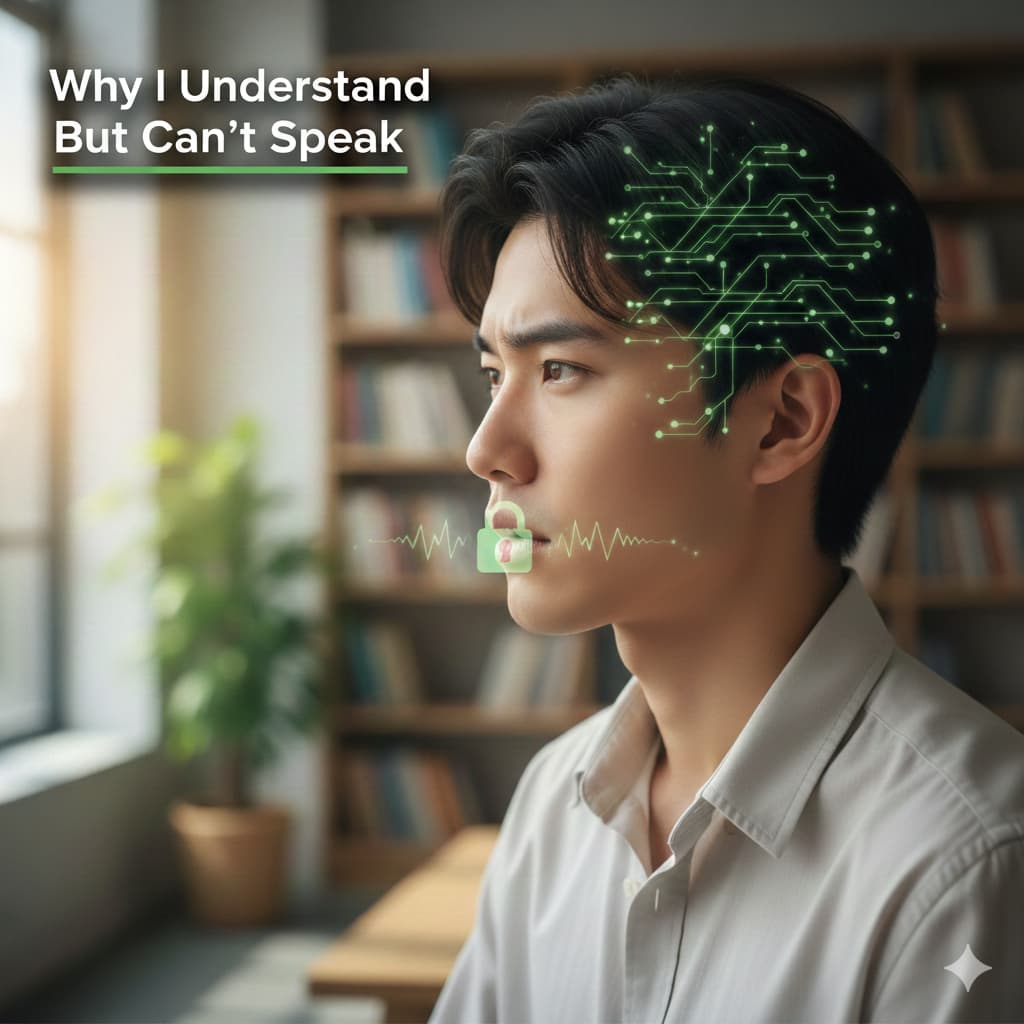
Do you ever feel frustrated because you can read and understand English well, yet words just don’t come out when you need to speak? You are not alone. Many learners wonder why they understand English but can’t speak and if they will ever become fluent.
In this article, we will explore 7 key reasons for this common issue, along with practical strategies, real-life examples, and tips to help you finally speak English confidently.
7 Reasons Why I Understand English But Can’t Speak
1. Massive Passive Learning
Many learners focus heavily on passive learning, such as reading, listening, and memorizing words. While these methods are important, too much passive learning creates a gap between understanding and speaking.
For example, you might follow an English podcast perfectly, but struggle to explain it in your own words. This happens because your brain learns to recognize language but not to produce it.
Tip: Balance passive learning with active speaking exercises. Try repeating sentences aloud, summarizing what you read, or explaining ideas to yourself.
I remember when I was learning English in 2014, I was struggling to memorize words. When I memorized dozens of words, I would forget them quickly. Even listening was difficult for me — sometimes it took me a long time just to understand one or two words in a one-minute speech.However, no matter how long it took, I overcame these challenges. Now I can understand different accents much better. What made it easier for me was consistency. I always stayed motivated, and I truly believed that I could do it.
7 Honest Reasons an IELTS Preparation Course Online
2. Fear of Making Mistakes
Many learners recognize why they understand English but can’t speak: fear of making mistakes. You might hesitate, worried about grammar or pronunciation, which stops you from practicing.
Mistakes are essential for improvement. Native speakers make many mistakes but keep communicating. The key is practice, not perfection.
Exercise: Speak 5 sentences daily about your day, and don’t be afraid to make mistakes. Focus on getting your meaning across, not on being perfect.
I wanted to share the mistakes I made and what I learned from them. Whenever the teacher asked me to have a conversation with my classmates, I was very afraid, so I avoided speaking as much as possible. I thought my main problem was grammar — I studied grammar a lot — but speaking was still very difficult for me.
I was especially afraid of conversations because I didn’t want to make mistakes, be embarrassed, or be judged by others. Because of this fear, I avoided conversations almost every day, and that was a big mistake.
Later, I improved when I found some classmates who were willing to practice real conversations with me. We chose specific topics, and if someone went off topic, I would gently remind them to stay focused. This helped me build confidence step by step.
Another mistake I made was memorizing words without context. Memorizing words alone is very difficult, and you can forget them easily. What helped me most was learning words with sentences, because it teaches you how to use them naturally.
3. Lack of Speaking Practice
Understanding English requires different skills than speaking it. Without daily speaking practice, you will continue to question why you understand English but can’t speak.
Even if you read books or watch videos, your speaking skills won’t develop. Pronunciation, rhythm, and quick word recall need active practice.
Tip: Try to speak aloud for at least 15-30 minutes daily. Use apps, shadowing exercises, or practice in front of a mirror.
When I was learning English, lack of speaking practice was one of the biggest challenges for me. It was very difficult because I didn’t always have a friend or partner to speak with whenever I needed. At that time, we didn’t have easy access to AI tutors or active WhatsApp groups like we have today. Finding someone to practice with was not simple.
Most of the time, the only place I could speak English was at school. Even there, conversations were short — sometimes just one or two minutes, maybe five minutes at most. It was hard to find someone who was ready to practice regularly, and that slowed down my progress.
To solve this problem, I started speaking alone. On my way to school, I would talk to myself, imagine conversations, and sometimes debate different topics in my mind. Although it felt strange at first, it helped me become more comfortable with speaking.
Sometimes I visited classmates just to practice conversation, and occasionally I spoke with my teacher as well. It wasn’t easy, especially compared to today, where learners can join online groups, use AI, or find speaking partners instantly. Back then, practice required much more effort.
Looking back, I realize that these small efforts — even speaking alone — played a big role in improving my confidence and making English easier over time.
7 Proven Secrets: How to get a Band 7 in IELTS writing
4. Translating in Your Head
Many learners can understand English but can’t speak because they translate everything from their native language. This slows down their ability to speak and creates hesitation.
Strategy: Think directly in English. Describe your surroundings, feelings, or tasks in English first. Start with short, simple sentences and gradually make them more complex.
Example: Instead of thinking “I want to eat dinner,” think directly: “I eat dinner now.”
5. Limited Vocabulary for Speaking
It’s common to know words in writing but struggle to recall them while speaking. This often happens because vocabulary is memorized passively rather than actively.
Create a speaking notebook. Choose 5-10 words daily and use them in sentences aloud. Focus on words you need for conversation, not just academic terms.
Example: Instead of only memorizing “photosynthesis,” learn phrases like “I take a photo” or “I enjoy walking in the forest.”
6. Anxiety or Pressure in Conversations
Some learners freeze up because speaking feels like a performance. Overthinking grammar, pronunciation, or correctness leads to mental blocks.
Strategy: Lower the pressure. Begin with low-stakes speaking situations: talk to yourself, record short audio notes, or practice with friendly peers. Focus on communication rather than perfection.
Example: Record a 2-minute diary entry each day. Listen later, notice improvements, and do it again.
7. Ineffective Learning Strategies
Lastly, many learners wonder why they understand English but can’t speak because they rely on outdated or ineffective learning methods.
Learning only from textbooks.
Memorizing grammar rules without speaking.
Avoiding real-life practice.
Better Approach: Use integrated learning methods that combine listening, speaking, reading, and writing. Active recall, shadowing, role-play, and daily routines can help you speak fluently.
Conclusion
Understanding why I understand English but can’t speak is the first step toward fluency. Most learners face one or more of these seven reasons. By balancing passive and active learning, embracing mistakes, practicing daily, thinking in English, expanding vocabulary, managing anxiety, and using better learning strategies, you can finally bridge the gap between comprehension and speaking.
Start small, stay consistent, and remember that everyone struggles at first. With the right approach, speaking English confidently will become natural.
Start applying one tip today. Choose a simple speaking exercise, record yourself, and notice the progress. Your journey to fluency begins now.